

If you run a manufacturing facility, pharma plant, IT park, data center, or commercial complex anywhere across Telangana or Andhra Pradesh, your power infrastructure is no longer a back-office concern — it’s a competitive advantage.
The two Telugu states are witnessing the fastest industrial expansion in South India. Hyderabad is now the world’s bulk drug capital with Pharma City spanning 19,000 acres. Visakhapatnam is becoming India’s data center capital with Google’s $15 billion AI hub and Reliance’s ₹1.6 lakh crore facility breaking ground. Sri City hosts over 200 multinational manufacturers. Genome Valley, HITEC City, Hyderabad’s Medical Devices Park, the Nakkapalli Bulk Drug Park, the Kakatiya Mega Textile Park — these aren’t just industrial zones, they’re load centers consuming massive amounts of electricity around the clock.
And every single one of them needs reliable, fast-deployable, code-compliant substation infrastructure.
This is exactly where packaged substations (PSS) and skid-mounted substations are replacing conventional brick-and-mortar substations across the region. In this guide, we break down why this shift is happening, which industries benefit most, and how Trinity Cleantech — manufactured right here in Telangana — is powering the change.
The Power Infrastructure Problem in Telangana & Andhra Pradesh
Both states have crossed major power milestones. Telangana’s installed capacity exceeds 20,400 MW. Andhra Pradesh has aggressively expanded thermal, solar, and wind capacity. But here’s the catch: generating power is one thing — distributing it reliably to industrial consumers is another.
Industrial users across both states face four recurring challenges:
1. Long lead times for conventional substations. A traditional outdoor substation requires civil works, land clearance, fencing, separate transformer foundations, control rooms, and 6 to 9 months of construction. For a new manufacturing line or expansion, this is unacceptable.
2. Land scarcity in industrial parks. Whether it’s HITEC City, Madhapur, Patancheru, Pashamylaram, Sri City, or APIIC parks in Visakhapatnam — every square foot is premium. Conventional substations consume 3 to 4 times more space than packaged units.
3. Voltage fluctuations and downtime risk. Pharma manufacturing, semiconductor fabs, data centers, and continuous-process plants cannot tolerate even momentary disruptions. A single voltage dip can wipe out a batch worth crores.
4. Compliance with IEC, BIS, and BEE standards. Inspectors from TSSPDCL, APSPDCL, CEIG, and DISCOM officials demand certified, factory-tested equipment — not site-assembled units of unknown quality.
Packaged substations solve all four problems in one compact, factory-built unit.
What Exactly Is a Packaged Substation? (And Why It Matters for Your Plant)
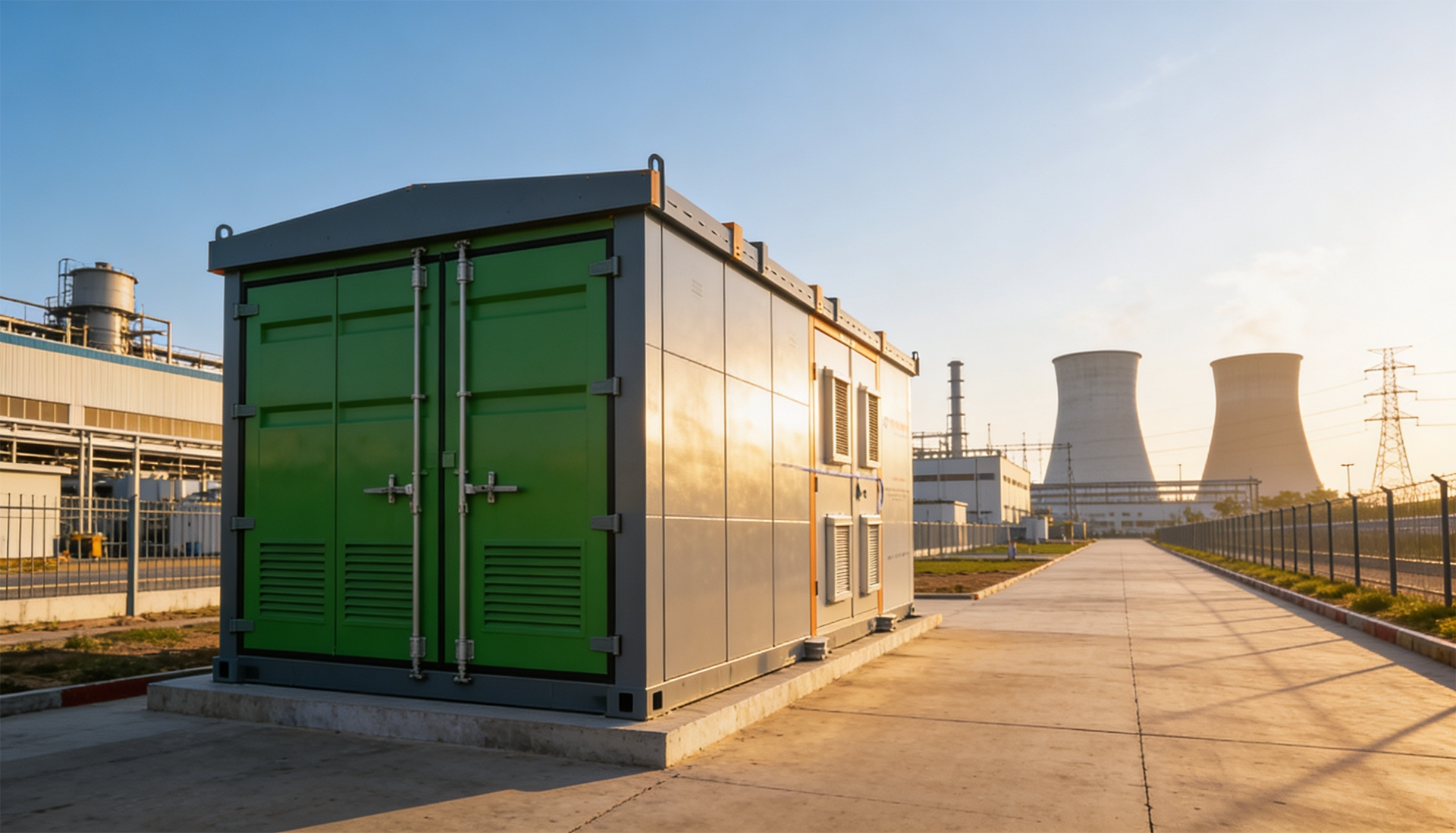
A Packaged Substation (PSS) is a complete power distribution system — HT panel, transformer, and LT panel — pre-assembled, pre-wired, and factory-tested inside a single weatherproof enclosure. It arrives at your site ready to be plugged into the grid.
Think of it as the difference between assembling furniture from raw timber on-site versus receiving a fully built piece delivered to your door. Both serve the same function. One takes weeks of skilled labor and quality risks. The other is operational the moment it lands.
A typical Trinity Cleantech PSS has three integrated cores:
The HT Panel receives 11 kV or 33 kV power from the DISCOM grid through a Ring Main Unit (RMU) or Vacuum Circuit Breaker (VCB), with built-in fault protection and earthing safety.
The Transformer (Trinity-manufactured, oil-filled, CRGO core, EC-grade copper windings) steps down voltage to 433 V — your usable industrial voltage — with low losses and BEE compliance.
The LT Panel distributes the stepped-down power across multiple feeder circuits with MCCB/ACB protection, metering, and optional APFC panels for power factor correction.
For larger installations above 2.5 MVA, skid-mounted substations offer the same factory-built reliability up to 5 MVA — ideal for large pharma plants, data centers, and steel/aluminum facilities.
Industries in Telangana & Andhra Pradesh That Benefit Most From Packaged Substations
Here’s where the rubber meets the road. Below are the specific industry segments across both states where Trinity Cleantech PSS units deliver measurable ROI.
1. Pharmaceutical & Bulk Drug Manufacturing
Where: Hyderabad Pharma City (Mucherla), Genome Valley (Shameerpet), Patancheru, Pashamylaram, Bonthapally, Jeedimetla, Nakkapalli Bulk Drug Park, Visakhapatnam Pharma SEZ.
Telangana contributes one-third of India’s pharmaceutical production and one-fifth of exports — over ₹52,000 crore in FY25 alone. Andhra Pradesh’s Nakkapalli Bulk Drug Park is targeting ₹11,500+ crore in investments. Pharma facilities run 24×7 fermentation, reactor cooling, HVAC, and cleanroom loads — all of which demand uninterrupted, regulated power.
Why PSS works for pharma: Compact footprint inside SEZ plots, IP54 outdoor rating for tropical conditions, redundant protection for critical batch processes, and BIS certification for inspector approvals.
2. Data Centers & IT Parks
Where: HITEC City, Gachibowli, Madhapur, Pocharam, Adibatla (Hyderabad), Visakhapatnam (Google AI Hub, Reliance, Sify, AdaniConneX), Tirupati IT corridor.
Visakhapatnam alone is set to host over 2.5 GW of data center capacity by 2030. Hyderabad already has 350+ Global Capability Centers. Every data center needs N+1 or 2N redundant power architecture, with substations for utility intake, captive backup integration, and floor-level distribution.
Why PSS works for data centers: Factory testing eliminates commissioning surprises, modular design supports phased capacity expansion, and skid-mounted units up to 5 MVA handle hyperscale floor loads.
3. Aerospace, Defense & Precision Engineering
Where: Adibatla Aerospace SEZ, Hardware Park (Hyderabad), HMDA industrial corridors, Sri City (defense electronics).
Companies like Tata Boeing, Lockheed Martin, and precision component manufacturers across Hyderabad’s aerospace cluster operate sensitive CNC machinery, EDM equipment, and clean assembly lines that require stable, harmonics-free power.
Why PSS works: Integrated APFC panels manage power factor, reducing penalties and improving equipment lifespan.
4. Textiles, Apparel & Mega Parks
Where: Kakatiya Mega Textile Park (Warangal), Sircilla, Apparel Park (Gundlapochampalli), Brandix India Apparel City (Visakhapatnam), Achutapuram SEZ.
Spinning mills, dyeing units, and integrated textile parks have spiky load patterns from motors, dryers, and compressors. The Kakatiya Mega Textile Park alone is built to host 50+ units.
Why PSS works: Quick deployment matches the rapid build-out timelines of textile parks; LT panels handle motor-heavy switching loads cleanly.
5. Automotive & EV Manufacturing
Where: Zaheerabad, Hyderabad ORR auto cluster, Chittoor (Kia Motors ecosystem), Sri City (Isuzu, Kobelco, Foxconn EV components), Anantapur (Kia plant).
Andhra Pradesh’s automotive ecosystem around Kia in Chittoor and the supplier base in Sri City consumes substantial industrial power. EV component manufacturers — battery assembly, motor winding, casting — are emerging fast.
Why PSS works: Trinity PSS units are specifically engineered for EV-related infrastructure, with 25+ units already energizing EV networks across India.
6. Food Processing, Agro & Cold Chain
Where: Mahbubnagar agro-belt, Nizamabad, Karimnagar, Rajahmundry, Krishna and Godavari delta processing units, aquaculture parks along the AP coast.
Andhra Pradesh contributes 41% of India’s fish production and 30% of seafood exports. Cold storage, IQF freezing, and processing plants require continuous power for refrigeration compressors.
Why PSS works: Compact units fit alongside cold rooms and processing halls; weatherproof enclosures handle humid coastal conditions.
7. Commercial Real Estate, IT Parks & Smart Cities
Where: GHMC commercial corridors, Financial District, Amaravati capital region, Tirupati, Vizag smart city projects.
Modern IT parks, malls, hospitals, and high-rise commercial buildings need 1–2.5 MVA of reliable power with minimal real estate impact. Hyderabad now has the second-largest skyscraper count in India after Mumbai.
Why PSS works: Indoor IP23 or outdoor IP54 versions fit basement utility rooms or rooftop plant areas; aesthetically compatible with modern architecture.
8. Steel, Cement, Chemicals & Heavy Industry
Where: Visakhapatnam Steel Plant ecosystem, ONGC Kakinada, Jindal facilities in AP, cement units across Tandur, Nalgonda, Kurnool, Krishna districts.
Heavy industry demands skid-mounted substations up to 5 MVA at 33 kV. Trinity manufactures both, with skid frames suitable for indoor halls or custom shelter housings.
9. Renewable Energy Projects & Solar Parks
Where: Anantapur solar park, Kurnool ultra-mega solar, rooftop solar across Telangana commercial buildings, hybrid wind-solar projects in coastal AP.
Solar parks need step-up substations to evacuate generated power to the grid. Skid-mounted designs reduce installation time on remote sites.
10. EV Charging Infrastructure
Where: Hyderabad ORR charging corridors, NH-44 and NH-65 highway charging stations, Visakhapatnam-Vijayawada-Tirupati EV corridor.
Trinity Cleantech has already energized 25+ PSS units in EV networks across India, with deep expertise in matching transformer ratings to fast-charger profiles.
Why Trinity Cleantech Is the Right Substation Partner for Telangana & Andhra Pradesh
Choosing a substation manufacturer isn’t just about specifications — it’s about local responsiveness, certifications, after-sales presence, and engineering depth. Here’s why industries across both states choose Trinity Cleantech:
Manufactured locally in Telangana. Trinity’s 20+ acre facility at TSSIC Green Industrial Park in Jadcherla, Mahbubnagar district, is roughly 80 km from Hyderabad and within 8 to 10 hours of any industrial site in either state. This translates to faster site visits, quicker deliveries, and emergency support that imported or out-of-state alternatives can’t match.
Full certification stack. BIS certified, ISO 9001:2015, ISO 14001:2015, ISO 45001 compliant, and engineered to IEC 62271-202. Every unit is 100% factory-tested before dispatch.
End-to-end EPC capability. Trinity doesn’t just sell equipment — they handle Engineering, Procurement, and Construction. Design, transformer manufacturing, panel integration, site commissioning, and commissioning support all under one roof.
Annual production capacity of 675 MVA. Whether you need a single 250 kVA unit for a small facility or a fleet of 2.5 MVA units for an entire industrial park, capacity isn’t a bottleneck.
Custom configurations. From 100 kVA to 2.5 MVA in packaged form, and up to 5 MVA in skid-mounted form, with customizations for ratings, enclosure type (IP54 outdoor / IP23 indoor), switchgear (630 A or 1200 A VCB), and integration with renewable or EV systems.
Track record across 18+ states. Trinity has delivered into every major industrial geography in India — and is rooted in the Telugu states.
How to Decide What Your Facility Needs
Three quick questions narrow down your specifications:
1. What’s your connected load? Below 2.5 MVA at 33 kV — you likely need a Packaged Substation. Above 2.5 MVA up to 5 MVA — a Skid-Mounted Substation is the right fit. Multiple units in parallel handle larger loads.
2. Indoor or outdoor installation? Outdoor installations need IP54 weatherproof enclosures (standard for Telangana/AP tropical climate). Indoor installations in industrial halls can use lighter IP23 versions.
3. What’s your timeline? A site-built conventional substation takes 6–9 months. A Trinity PSS can be delivered, installed, and commissioned in 8–12 weeks from order confirmation, depending on customization.
If you’re unsure, Trinity’s engineering team will visit your site, study your single-line diagram, and recommend a configuration with clear cost-benefit comparison against conventional alternatives.
How to Choose the Right Packaged Substation: 8-Step Guide
Step 1: Calculate Your Connected Load and Demand Load
Add up the kW or kVA rating of every motor, machine, lighting load, HVAC, and process equipment in your facility. Apply a diversity factor (0.7 to 0.85 for most industrial sites) and add 20–30% headroom for future expansion.
Step 2: Assess Your Site Conditions
Measure available installation area. Indoor sites use IP23 enclosures; outdoor sites need IP54. Coastal AP sites near Visakhapatnam or Kakinada need anti-corrosion treatment.
Step 3: Determine Voltage Class and Switchgear Rating
Confirm your DISCOM incoming voltage (11 kV or 33 kV). Choose 630 A or 1200 A VCB based on your inrush load profile.
Step 4: Select Packaged vs Skid-Mounted
Below 2.5 MVA — go Packaged. Above 2.5 MVA up to 5 MVA — go Skid-Mounted. Beyond 5 MVA — parallel multiple units.
Step 5: Verify Certifications
Insist on IEC 62271-202, BIS, ISO 9001, ISO 14001, ISO 45001 compliance and factory test certificates.
Step 6: Plan DISCOM and CEIG Approvals
Submit SLD and equipment specs to TSSPDCL/TGSPDCL/APSPDCL. CEIG approval is mandatory beyond certain capacities.
Step 7: Integrate Solar, DG, or EV Loads
Specify renewable integration, DG synchronization, APFC, and EV feeder circuits during the design phase.
Step 8: Request a Free Site Survey
Contact Trinity Cleantech at +91 80192 38877 for a free engineering consultation anywhere in Telangana or Andhra Pradesh.
Frequently Asked Questions
Q: How long does it take to commission a Trinity PSS at our site in Telangana or Andhra Pradesh? Typical lead time is 8 to 12 weeks from order to commissioning, including manufacturing, transportation from Jadcherla, civil interface preparation, installation, and testing. Site distance within both states adds minimal time.
Q: Will the same PSS work in coastal Andhra Pradesh’s humid, salt-laden environment? Yes. Trinity’s IP54 outdoor enclosures with appropriate paint specifications and ventilation are designed for coastal conditions. Special anti-corrosion treatments are available for sites near Visakhapatnam, Kakinada, and Nellore.
Q: Do you handle DISCOM approvals with TSSPDCL, TGSPDCL, and APSPDCL? Yes. Trinity provides full documentation, type test certificates, and engineering drawings required for DISCOM and CEIG approvals, and supports your team through the approval process.
Q: Can the substation integrate with our existing solar plant or DG backup? Absolutely. Trinity designs PSS units with provisions for solar integration, DG synchronization, and bus coupling for redundant supply schemes.
Q: What kind of after-sales support is available? Trinity provides AMC packages, preventive maintenance visits, spare parts availability, and emergency response from the Hyderabad and Jadcherla teams across Telangana and Andhra Pradesh.
Get a Free Substation Assessment for Your Site
If you’re planning a new facility, expanding existing capacity, or upgrading aging substation infrastructure anywhere in Telangana or Andhra Pradesh — from Hyderabad to Visakhapatnam, Warangal to Tirupati, Sri City to Nakkapalli — Trinity Cleantech’s engineering team can help you specify the right solution.
Here’s what you get when you request a consultation:
✅ Free site survey and load assessment by Trinity engineers ✅ Customized single-line diagram and substation specification ✅ Transparent quotation with timeline and compliance documentation ✅ ROI comparison against conventional substation alternatives ✅ Post-installation AMC and support coverage across both states
📞 Talk to a Trinity Cleantech expert today: +91 80192 38877 📧 Email: marketing@trinitycleantech.com 🏭 Visit our manufacturing plant: TSSIC Green Industrial Park, Jadcherla, Mahbubnagar District, Telangana 🏢 Corporate Office: Sarojini Devi Road, Secunderabad, Telangana
👉 Request a Free Quote | 👉 Talk to Our Experts
Trinity Cleantech — Engineering reliable power infrastructure for India’s most ambitious industries, manufactured right here in Telangana.
