

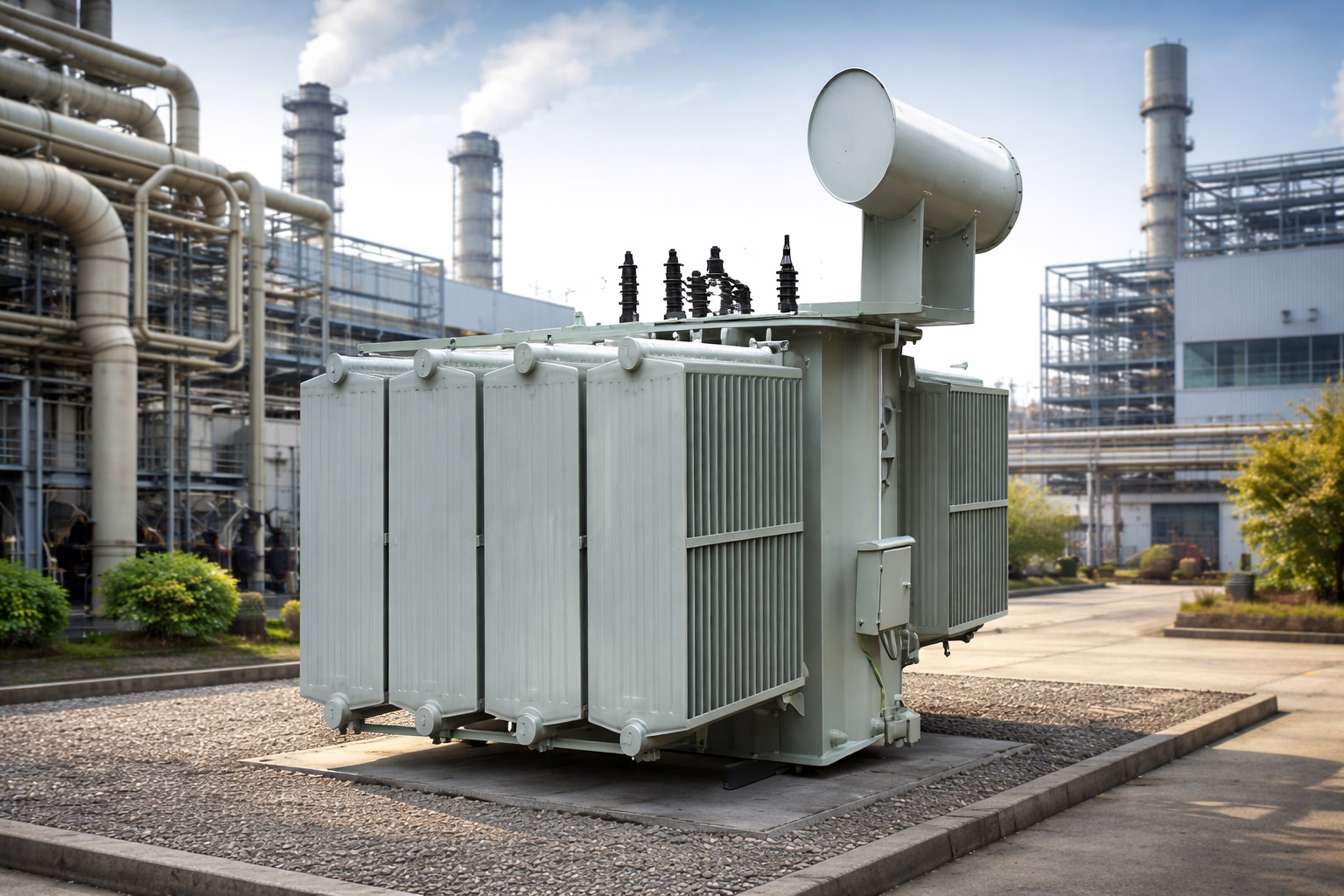
India’s power sector is in the middle of its most significant transformation in decades. With the government’s ₹3.03 lakh crore Revamped Distribution Sector Scheme (RDSS), growing EV charging infrastructure, expanding renewable energy capacity, and rapid urbanisation across Hyderabad, Vijayawada, and Visakhapatnam — the demand for high-quality distribution transformers in India has never been stronger.
Whether you are an electrical consultant specifying equipment for a new industrial plant, a DISCOM engineer replacing ageing infrastructure, or a project developer building a solar farm in Telangana, this guide covers everything you need to know about distribution transformers — what they are, the different types available, how to select the right KVA rating, and why the manufacturer you choose makes all the difference.
What Is a Distribution Transformer?
A distribution transformer is an electrical device that steps down high-voltage electricity from the distribution network — typically 11 kV or 33 kV — to a lower, usable voltage such as 433V or 230V for delivery to homes, factories, commercial buildings, and industrial facilities.
Unlike power transformers that operate at the transmission level, distribution transformers are the final link in the electricity supply chain. They are installed at every substation, industrial premises, housing complex, and utility feeder point — making them the most widely used transformer type in India.
Quick Answer : A distribution transformer converts high-voltage electricity from the grid into lower, usable voltage for end consumers. It is a three-phase or single-phase device installed at the last mile of the power distribution network and is a critical component in every residential, commercial, and industrial power supply system.
Why Distribution Transformer Demand Is Surging in India
India’s distribution transformer market was valued at USD 1.80 billion in 2025 and is projected to reach USD 2.76 billion by 2030, growing at a CAGR of nearly 9%. Several forces are driving this growth simultaneously:
RDSS — Revamped Distribution Sector Scheme The government’s flagship grid modernisation programme has sanctioned 5 million new distribution transformers for utility upgrades nationwide. With only a fraction installed so far, a significant order backlog will sustain procurement through at least 2027, directly benefiting manufacturers in Telangana and Andhra Pradesh.
Renewable Energy Integration India’s installed renewable capacity crossed 226 GW by mid-2025. Every solar farm, wind project, and rooftop solar installation requires step-up or distribution transformers to connect to the grid. Telangana and Andhra Pradesh — both major solar states — are significant contributors to this demand.
EV Charging Infrastructure Fast chargers in the 150–350 kW range require dedicated distribution transformers capable of handling rapid, high-load cycling. As EV adoption accelerates across Hyderabad, Vijayawada, and Visakhapatnam, transformer demand from the mobility sector is growing sharply.
Urbanisation & Smart Cities With India’s urban population expected to cross 500 million by 2030, new townships, metro rail projects, data centres, IT parks, and commercial complexes across Telangana and Andhra Pradesh are continuously adding transformer installations.
Industrial Growth in AP & Telangana Pharma, steel, cement, food processing, and logistics industries expanding across the two states require reliable, high-capacity three-phase distribution transformers to run continuous production operations.
Types of Distribution Transformers — Which One Do You Need?
Choosing the right type of distribution transformer is critical. Here is a straightforward breakdown of the main types available in India:
Oil-Cooled Distribution Transformers (ONAN) The most widely used type in India. These transformers use mineral oil as both coolant and insulating medium. They are robust, cost-effective, and suitable for outdoor installations including utility substations, industrial premises, and rural feeder points. Trinity Cleantech manufactures oil-cooled distribution transformers from 100 KVA to 2500 KVA, BIS-approved and built for India’s demanding operating conditions.
Sealed (Hermetically Sealed) Distribution Transformers A specialised variant of oil-cooled transformers where the tank is completely sealed — no conservator, no breather, zero air contact with oil. Ideal for coastal areas, dusty industrial environments, and remote locations where maintenance access is difficult. Trinity Cleantech manufactures sealed distribution transformers from 250 KVA to 2500 KVA. These are the preferred choice for industries in Visakhapatnam, Kakinada, and other coastal AP regions.
Dry-Type Distribution Transformers Use air as the cooling medium with no oil involved. Suitable for indoor installations in hospitals, data centres, high-rise buildings, and areas with strict fire safety requirements. Growing in urban metro areas due to fire-safety regulations.
Amorphous Core Distribution Transformers Use amorphous metal alloy cores instead of conventional silicon steel, delivering significantly lower no-load losses. Increasingly specified under RDSS and energy efficiency mandates. Best suited for applications running continuously at low load levels.
Pole-Mounted Distribution Transformers Single-phase or small three-phase units (16 KVA to 100 KVA) mounted on poles for rural electrification and last-mile connectivity. Widely deployed by DISCOMs across rural Telangana and Andhra Pradesh.
Pad-Mounted Distribution Transformers Ground-level enclosed units used in urban areas, residential layouts, and EV charging hubs where aesthetics and safety are priorities. All connections are underground, making them suitable for smart city deployments.
Distribution Transformer KVA Ratings — Selection Guide
Selecting the correct KVA capacity is one of the most important decisions in any electrical project. Here is a quick reference guide:
| KVA Rating | Typical Application |
|---|---|
| 16–63 KVA | Rural electrification, small residential feeders, pole-mount |
| 100–250 KVA | Small factories, commercial complexes, residential colonies |
| 315–500 KVA | Medium industries, IT parks, educational campuses |
| 630–1000 KVA | Large industrial plants, logistics hubs, hospitals |
| 1250–2500 KVA | Heavy industries, steel plants, large substations, EV hubs |
Trinity Cleantech manufactures distribution transformers from 100 KVA to 2500 KVA (standard range) covering the vast majority of industrial, commercial, and utility applications across Telangana and Andhra Pradesh. Custom ratings and voltage configurations are available on request.
Key Technical Specifications to Check Before Buying
When evaluating a distribution transformer from any manufacturer in India, verify these parameters:
BIS Certification (IS 1180): Mandatory for all oil-immersed distribution transformers sold in India. Non-BIS transformers cannot be used in DISCOM or government projects.
No-Load Losses (Core Loss): Lower is better. Specify Star-1 or Star-2 rated transformers under BEE’s energy efficiency star rating scheme to reduce long-term electricity costs.
Load Losses (Copper Loss): Directly impacts efficiency under full-load conditions. Ask for the certified test report showing load loss values.
Impedance Voltage (%): Typically 4–5% for distribution transformers. Affects fault current and voltage regulation.
Vector Group: Dyn11 is standard for most 3-phase distribution applications. Verify compatibility with your network configuration.
Temperature Rise: Should not exceed 55°C for oil and 60°C for winding above ambient — per IS 1180.
Tap Changer: Off-circuit tap changer (OCTC) with ±2 × 2.5% taps is standard. On-load tap changers (OLTC) are available for voltage-sensitive applications.
Distribution Transformer Applications Across Telangana & Andhra Pradesh
Trinity Cleantech’s distribution transformers are deployed across a wide spectrum of sectors in Southern India:
- TSSPDCL & TSNPDCL (Telangana DISCOMs): Utility-grade BIS-certified transformers for urban and rural distribution networks across Hyderabad, Warangal, Karimnagar, Nizamabad, and beyond.
- APEPDCL & APSPDCL (Andhra Pradesh DISCOMs): Reliable distribution transformers for AP’s rapidly expanding grid, including coastal zones and agricultural feeders.
- Pharmaceutical & Life Sciences (Genome Valley, Hyderabad): Uninterrupted, stable power for clean-room manufacturing and R&D facilities.
- IT & Technology Parks (HITEC City, Gachibowli, Amaravati): Continuous uptime-critical power for data centres and large tech campuses.
- Steel & Heavy Industry (Visakhapatnam, Warangal): High-capacity three-phase transformers for energy-intensive production processes.
- Solar & Renewable Projects (Kurnool, Anantapur, Nizamabad): Step-up and distribution transformers for utility-scale solar parks and rooftop solar systems.
- Real Estate & Housing (Vijayawada, Hyderabad, Tirupati): Compact, low-maintenance transformers for residential townships and commercial complexes.
- EV Charging Infrastructure: Transformers paired with Trinity’s own fast chargers for seamless, end-to-end EV power solutions.
- Ports & Logistics (Visakhapatnam, Kakinada): Robust, sealed transformers for high-humidity marine and port environments.
How to Choose the Right Distribution Transformer Manufacturer in India
With dozens of manufacturers across the country, selecting the right partner is critical. Here is what to evaluate:
BIS Approval is non-negotiable. Every transformer sold in India for utility or industrial use must carry BIS certification under IS 1180. Always ask for the BIS licence number and verify it.
In-house testing capability. A manufacturer with on-site test labs can certify every unit before dispatch — not just batch-test. This includes routine tests (winding resistance, ratio, short circuit impedance) and, where required, type tests.
Local manufacturing = faster support. A manufacturer based in Telangana or Andhra Pradesh can provide faster delivery, easier logistics, and on-site commissioning support compared to suppliers based in distant states.
Track record with DISCOMs. Manufacturers who have supplied to TSSPDCL, TSNPDCL, APEPDCL, or APSPDCL have already passed government vendor qualification — a reliable indicator of quality and compliance.
Warranty and after-sales service. Confirm the warranty period (typically 12–24 months) and whether the manufacturer has a service team in your region.
The Trinity Cleantech Advantage for Telangana & Andhra Pradesh
Trinity Cleantech, headquartered in Secunderabad and manufacturing at Jadcherla (Mahbubnagar district, Telangana), is one of South India’s most trusted distribution transformer manufacturers. Here is what sets Trinity apart:
BIS-Approved, Every Unit: All distribution transformers are certified under IS 1180 — fully compliant for DISCOM tenders, government projects, and private industrial installations.
100 KVA to 2500 KVA Range: Standard oil-cooled and sealed distribution transformers available across the full commercial capacity range. Custom voltage ratios and vector groups on request.
20+ Acre State-of-the-Art Facility: Located in Jadcherla Green Industrial Area, approximately 80 km from Hyderabad. Equipped with advanced manufacturing automation and in-house testing laboratories.
End-to-End Power Solutions: Trinity doesn’t just supply transformers. The company also manufactures packaged substations, EV chargers, and off-grid energy systems — making it a single-source partner for complete power infrastructure projects.
Made in Telangana: Local supply chain means faster delivery timelines, lower logistics costs, and dedicated after-sales support for customers across Hyderabad, Vijayawada, Visakhapatnam, and the surrounding districts.
Cities We Serve
Telangana: Hyderabad · Secunderabad · Warangal · Karimnagar · Nizamabad · Khammam · Mahbubnagar · Nalgonda · Sangareddy · Medchal
Andhra Pradesh: Vijayawada · Visakhapatnam · Guntur · Tirupati · Nellore · Kakinada · Kurnool · Rajahmundry · Ongole · Eluru
Frequently Asked Questions
What is the difference between a power transformer and a distribution transformer?
A power transformer operates at high voltages (above 33 kV) and is used for bulk electricity transmission between substations over long distances. A distribution transformer operates at lower voltages (typically 11 kV or 33 kV input, 433V output) and delivers power directly to end consumers — homes, factories, and commercial buildings. Distribution transformers are installed in far larger numbers and are the final step in the electricity supply chain.
What KVA rating do I need for my factory or industrial unit?
This depends on your connected load. As a general rule, calculate your total connected electrical load in kW, divide by the power factor (typically 0.8–0.9), and add 20–25% safety margin. For example, a factory with 400 kW connected load would require approximately a 500–630 KVA transformer. Trinity Cleantech’s engineering team can help you size the right unit for your specific application — call +91 8019238877.
Are distribution transformers from Trinity Cleantech BIS certified?
Yes. All Trinity Cleantech distribution transformers carry BIS approval under IS 1180, making them eligible for DISCOM tenders, RDSS projects, and all government and private industrial installations in India.
What is the difference between a sealed and a standard oil-cooled distribution transformer?
A standard oil-cooled transformer uses a conservator tank and breather, meaning the oil is in contact with atmospheric air over time — which can allow moisture ingress. A sealed (hermetically sealed) transformer has a completely closed tank with no air contact, eliminating moisture ingress and oxidation entirely. Sealed units are maintenance-free and preferred for coastal, dusty, or remote locations.
How long does a distribution transformer last?
A well-maintained oil-cooled distribution transformer typically lasts 20–25 years. Sealed distribution transformers, with virtually no maintenance requirements, can last 25–30 years. Amorphous core units also offer extended life due to lower operating temperatures.
What government schemes are driving distribution transformer demand in India?
The Revamped Distribution Sector Scheme (RDSS) is the primary driver, with ₹3.03 lakh crore allocated for DISCOM modernisation including 5 million new transformer installations. PM-KUSUM supports solar-powered agricultural feeders. The National Electricity Plan also calls for massive transmission and distribution investment through 2032. These schemes create a sustained, multi-year procurement pipeline for quality Indian transformer manufacturers.
How do I get a quote for a distribution transformer in Hyderabad or Andhra Pradesh?
Contact Trinity Cleantech directly at +91 8019238877 or email marketing@trinitycleantech.com. Share your KVA requirement, voltage ratio, installation environment (indoor/outdoor, coastal/inland), and any special features needed. Our team will provide a specification sheet and competitive quotation.
Get in Touch
📞 +91 8019238877 ✉️ marketing@trinitycleantech.com 🌐 www.trinitycleantech.com
📍 Office: 9-1-83 & 84, Amarchand Sharma Complex, Sarojini Devi Road, Secunderabad, Telangana – 500003 📍 Plant: Jadcherla Green Industrial Park, Mahbubnagar, Telangana – 509302
